



Background
Cleanrooms are defined as a room or suite of rooms, in which the concentration of airborne particles is maintained within established parameters and where other factors are controlled to within specified limits. These rooms are designed to provide control of environmental factors including:
- Viable and non-viable airborne particles
- Air flow patterns
- Temperature and humidity
- Air pressure differential
- Containment of hazardous aerosols
Applications include the manufacture of sterile and non-sterile pharmaceutical and biotech products, medical devices, and implants. These rooms are also used to manufacture sensitive electronics. However, the requirements for these latter applications are not the objective of this article. GMP requirements from the different Boards of Health, including the US Food and Drug Administration (FDA), for sterile pharmaceutical, biotech, medical devices and implants require the manufacture of these products are performed in clean environments that meet the requirements of standards such as ISO EN146441.
Compliance Requirements:
- FDA Guideline Sterile Drug Products Produced by Aseptic Processing
- European Union (EU) GMP Annex 1 Manufacture of Sterile Medicinal Products
Other Helpful Documents:
- ISO EN14644-1, -2
- International Society for Pharmaceutical Engineering (ISPE)
Air Handling Requirements
Room air should be supplied by an external air conditioning system, preferably dedicated to the facility. Partial recirculation of room air is appropriate and this allows for optimal energy utilization. Sufficient fresh air should be supplied in accordance with ventilation codes, to balance exhaust air and to maintain specified pressures. Unless, otherwise specified, typical temperature range for this kind of room is within the range of 16 to 19 °C and relative humidity of approximately 50% is maintained.
Only HEPA filtered air should enter the cleanroom and the gowning areas. These modules are available in fan assisted with fan speed control and should operate at a velocity of 90 ± 10 fpm or 0.45 ± 0.05 m/s. The location of the HEPA filters and air return grilles should create air movement from the designated ‘clean zone’ to the ‘less clean’ zones. Return air grilles should be at a lower level to aid in laminar flow requirements.
Air supply to the cleanroom should provide a room air change rate of >20 per hour. Air cleanliness will be enhanced by higher air change rates. When the doors are opened the supply air volume should maintain an outward flow of air.

*Requirements for particle counts during operation are different from class A, 35,200 particles at 0.5 μ
Sources of Contamination
In order to control contamination, operators and those in charge of a cleanroom need to be cognizant of sources of contamination. These include:
- Facilities: walls, floors and ceilings; paint and coatings; spills and leaks
- People: skin flakes and oil; cosmetics and perfume; spittle; clothing debris (lint, fibers, etc.); hair
- Tool-generated: friction and wear particles; lubricants and emissions; vibrations; brooms, mops, and dusters
- Fluids: particulates floating in air; bacteria, organics, and moisture; floor finishes or coatings; cleaning chemicals; plasticizers (outgasses); water
- Product-generated: glass flakes; cleanroom debris; aluminum particles from vial caps
Key Elements of Contamination Control
Cleanroom Architecture – Cleanrooms are designed to achieve and maintain an airflow in which essentially the entire body of air within a confined area moves with uniform velocity along parallel flow lines. This air flow is called laminar flow. The more restricted the air flow, the more turbulence and this can cause undesireable particle movement.
Filtration – In addition to the HEPA filters commonly used in cleanrooms, there are a number of other filtration mechanisms used to remove particles from gases and liquids used in the manufacture of pharmaceutical products. These filters are essential for providing effective contamination control.
Cleanroom Garments – The requirements for cleanroom garments will vary from location to location. It is important to know the local cleanroom garment requirements. Gloves, face masks and head covers are standard in nearly every cleanroom environment as well as coveralls.
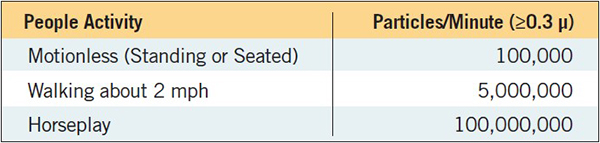
Personnel – There are both physical and psychological concerns when humans are present in cleanrooms. Physical behavior like fast motion and horseplay can increase contamination. Psychological concerns like comfort, claustrophobia, strong odors, and workplace attitude are important.
- Behavior: Rate of movement, sneezing and coughing
- Attitude: Work habits and communication between workers
People are a major source of contamination in the cleanroom. Notice the number of particles produced per minute during these activities:
Cleanroom Classifications
Cleanroom Classifications as specified by different standards show that non-sterile products are typically produced in an ISO 8 or EU Class D environment. Sterile products are required to be filled and stoppered in an ISO 5 or EU Class A environment.
Cleanroom Cleaning
Cleaning of an active cleanroom should be performed daily. Only products that have proven cleanroom performance records should be considered for use. These products should be listed in appropriate policies or procedures and all vendors should be informed about the strict policies of how products are qualified.
Equipment and Supplies:
- Cleaning and disinfecting solutions
- Cleanroom mops
- Cleanroom vacuum cleaner (if allowed)
- Cleanroom wipers
- Cleanroom mop bucket and wringer
Cleaning Tasks:
- Cleaning of all work surfaces in the controlled environment
- Vacuuming (if allowed) of the floors and work surfaces
- Emptying of appropriate trash and waste receptacles
- Cleaning of the doors, door frames and lockers in the pre-staging area and gowning areas
- Mop gowning area and cleanroom floors
General Cleanroom Requirements
- All personal items such as keys, watches, rings, matches, lighters and cigarettes should be stored in the personal locker outside the gowning room.
- No eating, smoking or gum chewing is allowed inside the cleanroom.
- No cosmetics shall be worn in the cleanrooms.
- Only approved cleanroom paper shall be allowed in the cleanroom.
- Gloves should not be allowed to touch any item or surface that has not been thoroughly cleaned.
- No tool should be allowed to rest on the surface of a bench or table. It should be placed on a cleanroom wiper.
- All equipment, materials and containers introduced into a sterile facility must be subjected to stringent sterilization prior to entrance.
Definitions
HEPA Filter: High Efficiency Particulate Air Filter
Viable: a particle capable of living, developing, or germinating under favorable conditions, i.e., bacteria.
Non-viable: typically dust or liquid particles
Airborne: carried by or through the air
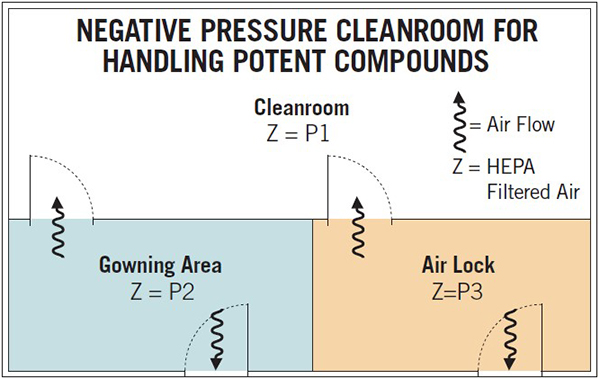
Cleanrooms for Handling Potent Compounds
For handling potent compounds, precautions need to be taken to avoid spreading the toxic material to adjacent areas. This may be achieved by maintaining a negative pressure differential between the cleanroom and adjacent area so any hazardous powder or aerosol is contained within the cleanroom. This is accomplished by designing the facility with HEPA filtered incoming air and providing HEPA filtration at the exhaust.
References
- ISO EN 14644-1, -2, -5, -9 International Standards Organization Cleanroom Standards
- FDA Guidance for Industry – Sterile Drug Products produced by Aseptic Processing – CGMP September 2004
- EU GMP Annex 1- Manufacture of Sterile Medicinal Products
- ISPE – International Society for Pharmaceutical Engineers